Anaconda
(1997, dir: Luis Llosa; cast: Jon Voight, Jennifer Lopez, Ice Cube, Eric
Stoltz, Jonathan Hyde)
Can a
giant snake make for a horror film? A horror story requires an unnatural
threat, thus while ferocious animals may make for an adventure film,
only unnatural animals make for horror. Jaws's
shark is not sufficiently unnatural to qualify as a horror threat. Anaconda's
snake is more abnormally large (hence, more unnatural) than Jaws's
shark, but it's still borderline. Still, Sony did market Anaconda as a horror film, and although studio marketing executives aren't concerned
with accuracy in selling their films, here's my review.
Eric Stoltz
is a university professor seeking a legendary rain forest tribe, reputedly
living along the Amazon river. Jennifer Lopez is the documentary
filmmaker hoping to record his discovery. Ice Cube belongs to Lopez's
film crew. Once they rent a boat, they journey into the primitive
and all its primordial horrors. There are other actors on the boat,
but they're mainly there to be eaten by the giant snake, so their characters
are unimportant.
They soon
come across a stranded boat containing Jon Voight, an ex-priest and snake
catcher. Knowing more than he lets on, Voight seeks to divert Stoltz
from his expedition so that Voight can capture the giant snake. Why
he can't hire a new boat is never made clear.
Anaconda depicts the usual stereotypes. Voight is the evil White Big Game
Hunter. Lopez is an Idealist who accuses him of poaching. She
frets over the ecosystem when Voight blows up a primitive native dam. Stoltz too is an idealist, but he's pretty useless. Although Stoltz
is something of a love interest for Lopez, it is Ice Cube who performs
the manly rescues. There's also an effete Brit (Jonathan Hyde) who
imperiously orders about the natives, lugs the usual inappropriate luxuries
into the jungle, and practices his golf swing on the boat while listening
to opera CDs.
As in
many adventure films, the Big Game Hunter has a keener understanding of
cruel Mother Nature than the eco-sensitive city slickers (Ice Cube and
Hyde pine for urban living). The boat descends ever deeper into the
heart of darkness, suffering mechanical mishaps, ignoring native taboos,
and disrespecting the ecosystem. As in Deliverance,
the crew must embrace the primitive if they are to survive and beat both
Voight and the snake.
In this
sort of film, the real star is the snake. It's big. It hisses. It's computer generated. But it doesn't show up as often, nor kill
as gruesomely, as horror fans may like. It's an okay snake, nothing
to be ashamed of. But there's only one memorable scene: the snake
regurgitating a partially digested, but still living person.
Once again
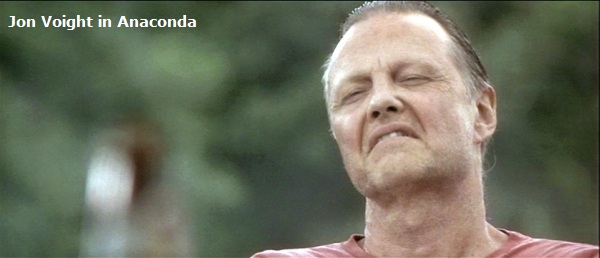
it's not the monster but the villain, Jon Voight, who steals the show. Voight is skin-crawlingly creepy, with a perpetually pronounced frown and
slits for eyes. (Is this a "method" thing, him trying to look like
a snake?). After due consideration, Ice Cube ventures to state that
there's something he doesn't like about Voight, and we think ... DUH!
Anaconda has a simple plot. City slickers venture into the jungle and a big
snake picks them off. This is a film about: Who will be eaten next? Voight is creepy fun to watch. Lopez is especially fun to watch after
her clothes get wet. And there's a giant snake that eats people. A pleasant time-killer, if no more.
Review copyright by Thomas
M. Sipos
"Communist Vampires" and "CommunistVampires.com" trademarks are currently unregistered, but pending registration upon need for protection against improper use. The idea of marketing these terms as a commodity is a protected idea under the Lanham Act. 15 U.S.C. s 1114(1) (1994) (defining a trademark infringement claim when the plaintiff has a registered mark); 15 U.S.C. s 1125(a) (1994) (defining an action for unfair competition in the context of trademark infringement when the plaintiff holds an unregistered mark).