|
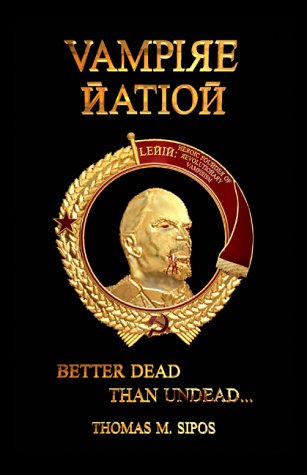
Gruesomely
hammers home the real evil of Communism, which was in some ways not that
far removed from Sipos's gory fictional renderings. The image of
the communist ruling class sucking the lifeblood of the very proletariat
whom it claims to champion is a brilliantly evocative image and a powerful,
original metaphor for Communism -- something one would have hardly thought
possible to achieve after all that has been written on the subject in the
past eight decades.
--
Mark Wegierski, American Outlook, Winter 2002
Vampire
Nation combines political dystopia, horror, espionage thriller, black comedy,
even a Boy Meets Girl story. But surprisingly enough, all these elements
hold together. The binding force is a single central idea: vampirism
as the ultimate form of communism, in which blood is redistributed from
producers to parasites. Romania in the last days of the Ceausescu
regime
provides exactly the right setting for this trope; Sipos even has a cameo
for the ghost of Vlad Tepes, the medieval tyrant on whom Bram Stoker based
the character of Dracula. A hallucinatory sequence near the end sketches
a larger historical context in which all the great tyrannical regimes were
actually run by monsters, with the French Revolution and Stalinism linked
to vampirism and Nazism to lycanthropy.
Sipos's
work
is exactly the sort of material small presses are meant for -- a little
rough in spots but with some real substance. Anyone who likes political
satire might find it worth a look.
-- William
H. Stoddard, Prometheus, June 2000 (newsletter of the Libertarian
Futurist Society)
Vampire
Nation attacks its subject matter from a libertarian perspective inspired
by Ayn Rand, Ronald Reagan's shoot-from-the-hip witticisms, and a quirky
sense of humor. ... It's a welcome relief from a world that thinks communism
is just as cool and froody as capitalism. That somehow enslaving
people in service to the state is actually a good idea. Heck, as
recently as the Elian Gonzoles case, folks were asserting that communism
is just another political system that's just as valid and moral as capitalism
(if not more so). ... It's great to read a book that takes that collectivist
BS and drives a stake through its oozing Red heart.
--
Ken Newquist, Nuketown.com, January 2001
A
fast-paced satire so dark and bloody, and so graphic in horrible bloodsucking
social and personal depravity, the average reader will likely reject it
with a "Yik!" ... Yet [Sipos] writes well and creates a Bucharest
of sinkhole, stomach-turning evil which is effective as horror. ... The
novel succeeds in portraying socialists as a ghastly race of vampires literally
sucking the lifeblood from the people. ... Altogether, this
is a strange, flawed, interesting, 'politically incorrect' novel undoubtedly
destined to be ignored by the mainstream media.
--
Richard E. Geis, Science Fiction Chronicle, May 2001
Vampire
Nation is a riveting, unique, superbly written horror novel, very highly
recommended for all fans of the vampire genre.
-- Able
Greenspan, Midwest Book Review,
May 2001 |
Henry
Willoughby, a likeable if callow American, is the hero of Vampire
Nation, a satiric horror fable about life in Communist Romania.
Willoughby is invited to shoot a horror film in Transylvania. But
from the moment he boards a Romanian flight, he encounters events that
make him wish he'd stayed home. ... Luckily, Henry meets Anya, a rogue
antivampire spy, and together they share adventures while overcoming evil
(including horrific encounters with head vampires Nicolae and Elena Ceausescu
and their truly disgusting son, Nicu). Sipos spins the familiar story
of a naive American encountering European decadence but gives that familiar
story
his own personal (and sometimes ornery) twist.
-- Stephen
Goode,
Insight magazine, August 7, 2000 (a publication of The Washington
Times)
Vampire
Nation both is and is not a horror novel. Sipos has thoroughly
messed about with the genre, and has pulled it off superbly, with a razor
sharp class. ... The book reads as if were written by Orwell, Stoker, Kafka,
and Swift sipping spiked martinis over at King's place. Sipos has
a unique voice, and although there is a sense of Animal Farm, 1984, The
Castle, and Gulliver's Travels about Sipos's book, it holds its own as
a
Siposian creation. (A masterful and distinct enough work is Vampire
Nation to coin a new adjective to describe it.) ... Somewhere between the
howls of dying vampires, the political and social jabs, and the shots of
guns, Sipos manages to guarantee it all falls together wonderfully as a
page-turner. It might seem tempting to classify such a book as "enlightening,"
but Vampire
Nation definitely is entertainment, and there is nothing wrong with
that.
--
Quinn
Tyler Jackson, Inner Sanctum, March 2001
Sipos mainly adheres to [historic]
reality, giving Vampire
Nation depth and giving the subgenre of vampire fiction a worthy addition.
Stating at the outset, "This is a work of satire inspired by history,"
Sipos implies that his vampires are symbols, but he does not create mere
stereotypes of villains. His vampires are fleshed out by the fact
that such individuals and the horrific communist realm they created were
very real. The author's list of relevant nonfiction works on communist
Romania initially made me consider him a possible Kim Newman wannabe. Nothing could be further from the truth. While the grand pageant
of history provides the backdrop for both authors, Sipos’ work can stand
on its own.
-- Stine Fletcher, Necropsy,
Spring 2001
Willoughby
and Amasovich begin a reckless ride throughout the Rumanian countryside
killing communists, who also happen to be blood-sucking socialists. Altogether the novel can be divided into one part John Rambo, one part
Blade, and one part Catherine Zeta Jones. ... The image of Willoughby and
Amasovich running through the Transylvanian moonlight slaying communist
vampires could probably be very profitable for some video game manufacturer.
--
John Sherry, The Eagle,
September 5, 2000 a publication of American University |