|
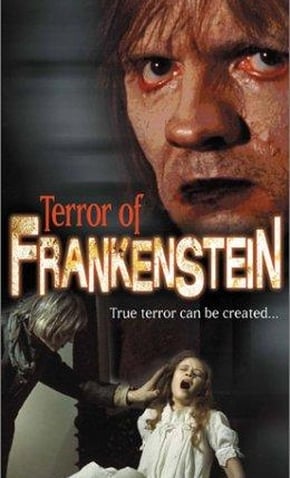
Terror of Frankenstein Film review by Thomas M. Sipos |
|
MENU Books Horror Film Festivals and Awards
Pursuits
Blogs Horror Film Festivals and Awards
Other
|
Terror of Frankenstein (Swedish-Irish, 1977; dir: Calvin Floyd, scp: Calvin Floyd & Yvonne Floyd; cast: Leon Vitali, Per Oscarsson, Nicholas Clay, Stacey Dorning, aka Victor Frankenstein)
No, it's nowhere near as stylish as James Whale's Bride of Frankenstein. Nor as gory as Hammer's Frankenstein cycle. Nor as humorously twisted as Andy Warhol's Frankenstein. What sets this obscure European co-production apart is that it is as its promotional material claims: a faithful adaptation of the Mary Shelley novel. Other productions claim that mantle. Terror of Frankenstein delivers. If you've read the book, you know the film. It opens in the Arctic Ocean, aboard a ship frozen in ice. Its captain seeks the North pole. Instead he encounters a Dr. Victor Frankenstein (Leon Vitali) stumbling about the ice floes, in search of a monster (Per Oscarsson). Rescued by the captain, Victor relates his story... The Frankenstein story has been filmed myriad times, and interpreted nearly as often. The monster is often portrayed as a simple brute. Whale portrayed him as a sympathetic mute, later capable of some halting phrases. (How long before the PC patrol censors the monster's joyful discovery: "Smoke good!" ?). Terror of Frankenstein follows Shelley's novel in portraying the monster as an eloquent advocate for his own defense, and for his demand that Victor create for him a bride. Not that he can't be cruel. Nor is he as verbose as in the Shelley novel. But then, the nature of film does not allow for a discourse that continues across several chapters in the book. Shelley's Frankenstein works on many levels, including as metaphor for the loneliness, resentment, and eventual hostility that results from societal rejection. Such emotional pains are especially common to adolescence, and make for a recurring horror theme (Carrie, Twisted Brain, Prom Night, Slaughter High). AIP's I Was a Teenage Frankenstein is noteworthy primarily because it is the Frankenstein adaptation that taps most explicitly into this theme of adolescent angst.
Terror of Frankenstein too focuses on this aspect of the novel. Newly born, full of wonder and delight at the beauty of nature, the monster is soon rejected and assaulted because of his horrid appearance. He angrily vows vengeance on all humanity, and kills the innocent. But, desiring a mate to assuage his loneliness, he promises Victor that he will make peace with humanity if Victor builds for him a bride "as ugly as I." Phil Hardy's Overlook Encyclopedia recognizes this, scoffing that the monster "like a true adolescent, feels repulsive and is left to cope alone in the world, causing it to develop into a brutal delinquent." Hardy would rather the film concentrate on the Baron's conflicts with society, lamenting, "Floyd's pretty pictures and psychological approach drain the myth of its power." I disagree. The monster's attempts to cope with rejection, more so than Victor Frankenstein's attempt to play God, is the thematic core of Shelley's novel; or at least, its the more interesting aspect. And Terror of Frankenstein, unlike most adaptations, highlights this core. Terror of Frankenstein is a low-budget effort, but this lack of funds enhances rather than hinders Floyd's thematic focus -- perhaps even directed him to it. The monster is unattractive, but more creepish than freakish. This may be less a matter of choice than of budgetary constraints. This monster has no expensive nuts and bolts, no elaborate makeup. His lips are blackened with lipstick, his face pallid with powder, his hair unkempt. He'd likely pass unnoticed in some parts of New York. His cadaverous (rather than monstrous) appearance supports the theme of a lonely outcast. He is the grimy, sickly bum we pass quickly on the street, his appearance menacing rather than terrifying. Terror of Frankenstein's simple makeup and effects demonstrate how low budgets constrain filmmakers into creative choices that aesthetically enhance a film's theme. Hence, the film is an example of pragmatic aesthetics. (By pragmatic aesthetics, I mean when a filmmaker puts budgetary production compromises to aesthetic effect. Forced to compromise on location, lighting, whatever, the filmmaker uses that limitation in a way that enhances the theme or story. I first used the term in my essay, "The Pragmatic Aesthetics of Low-Budget Horror Cinema," published under another title in Midnight Marquee #60. For a fuller explanation, see my book, Horror Film Aesthetics.)
Despite its low budget, Terror of Frankenstein is a handsome production. The old buildings Floyd found in his Irish locations support the story, and filming scenes of nature costs the same for a low-budget film as big budget. The period costumes are attractive. For stark beauty, the wintry forest scenes rival those in Ghost Story. Hardy dismisses Floyd's "pretty pictures" as being complicit in "draining the myth of its power," but I think otherwise. Terror of Frankenstein more convincingly evokes early nineteenth century Switzerland than many bigger budgeted films. The Arctic Ocean sets are also impressive. The most noticeable budgetary compromise is the background casting. The principals are all superb, but there are so few extras that the sets feel empty. Victor's vast mansion appears sparsely staffed with servants. The university appears to have enrolled only a handful of pupils. Even village squares are sparsely populated. No guests attend Victor's wedding to Elizabeth (Stacey Dorning); the spacious church is empty save for the necessary participants. (One rationale may be that they invited no guests out of mourning for the recent death of Victor's brother). But this is a minor matter. The film's low-budget production values and special effects can't match Hollywood. But the locations and laboratory props serve their purpose admirably, the cast performs well, the script is intelligent. Review copyright by Thomas M. Sipos
|
 All horror
fans worthy of the genre should see
All horror
fans worthy of the genre should see 
"Communist Vampires" and "CommunistVampires.com" trademarks are currently unregistered, but pending registration upon need for protection against improper use. The idea of marketing these terms as a commodity is a protected idea under the Lanham Act. 15 U.S.C. s 1114(1) (1994) (defining a trademark infringement claim when the plaintiff has a registered mark); 15 U.S.C. s 1125(a) (1994) (defining an action for unfair competition in the context of trademark infringement when the plaintiff holds an unregistered mark).